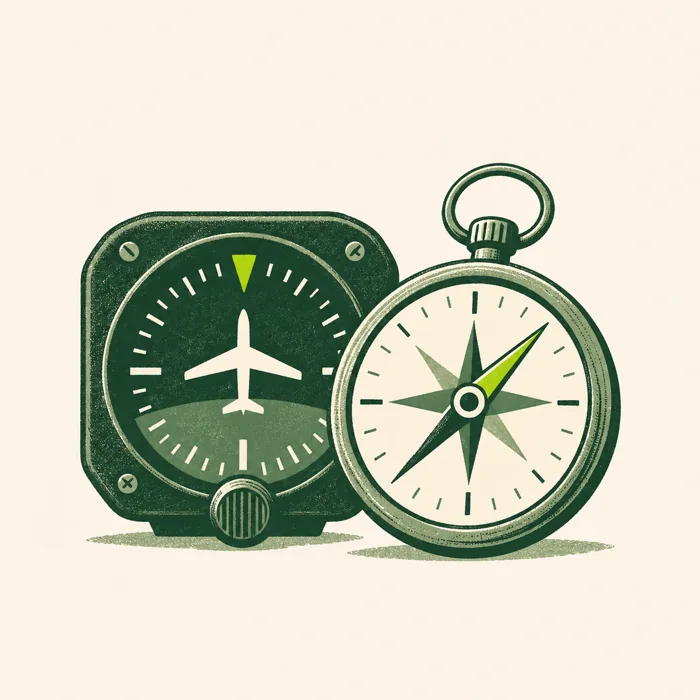
As a founder who also happens to be a pilot, I don't just see the parallels between the cockpit and the boardroom—I live them. Every time I settle into the left seat and review the flight plan, I'm struck by how similar it feels to facing down a quarterly review. Both disciplines demand vision, meticulous planning, calculated risk-taking, and swift decision-making under pressure. Whether I'm responsible for an eight-figure revenue target or a multi-ton aircraft, the core responsibility is the same: ensuring a safe, efficient, and successful journey for everyone who relies on my leadership.
1. Setting the course: Vision, flight plan and weather preparations
Before any journey begins, a pilot meticulously plots the flight plan. This involves selecting a destination, mapping the route, calculating fuel reserves, accounting for weather, and determining contingency plans. Based on the weather forecast, pilots must also factor in specific airways, altitude restrictions, approach procedures for low visibility, and potential holding patterns.
Similarly, a successful business leader must establish a clear vision and strategic business plan. This plan acts as the company's ultimate destination and operational roadmap. It outlines goals, allocates resources (like fuel), anticipates market conditions (like weather), and prepares for potential disruptions (like turbulence). Just as a pilot can't afford to be vague about the destination, a CEO must be definitive about the company's direction. The equivalent of the weather preparation in business is the deep dive into market analytics, competitive intelligence, and regulatory landscapes, allowing the company to navigate through periods of uncertainty or "low visibility" with a predefined, instrument-guided strategy.
2. Crew and Company: Teamwork and Communication
An aircraft’s safety hinges on the crew resource management (CRM)—the efficient use of all available resources, including personnel. The Captain relies on the First Officer, flight attendants, and ground control to execute the flight plan. Clear, concise, and timely communication is paramount, especially during emergencies. When flying in the clouds, communication extends to constant interaction with Air Traffic Control (ATC), where precise adherence to instructions and clear read-backs are non-negotiable for maintaining separation and safe passage through controlled airspace.
In business, the CEO is the Captain, but success is a team effort. They must build a strong executive team (First Officer) and empower employees (crew) to execute the strategic plan. Like CRM, effective business leadership requires open channels of communication, delegation, and mutual trust to ensure everyone is working toward the same objective, particularly when navigating a crisis or a challenging market period. The "Air Traffic Control" in business could be likened to external stakeholders, regulatory bodies, or key investors—entities that provide critical guidance and constraints, and with whom precise, transparent communication is essential for the company's trajectory.
3. Monitoring the Instruments: Data, Performance Metrics, and The Danger of Sensory Illusions (Spatial Disorientation)
A pilot is constantly monitoring the cockpit instruments: altimeter, airspeed indicator, fuel gauge, and engine performance. These metrics provide real-time, objective data essential for safe operation. In Instrument Flight Rules (IFR) conditions, when the natural horizon and outside visual cues are obscured by clouds, fog, or darkness, the reliance on these instruments is absolute.
The human body, particularly the inner ear, is susceptible to spatial disorientation when visual cues are lost. Under these conditions, the body can be tricked into feeling that the aircraft is turning, climbing, or diving when it is actually flying straight and level, or vice-versa.
The critical lesson for the pilot is this: Do not trust your senses; trust the instruments. If the pilot follows the deceptive feeling—the strong emotional impulse to correct a perceived, but unreal, roll or pitch—the result will be a loss of control, an unintended maneuver, and a likely fatal outcome. The instrument panel is the only objective reality.
The business world faces an identical danger. Business leaders rely on Key Performance Indicators (KPIs), financial reports, and market analytics as their "instrument panel." Monitoring metrics like revenue, profitability, cash flow, and customer satisfaction is critical for knowing the company’s true "altitude" and "airspeed."
The "spatial disorientation" for a CEO occurs when they allow emotion, internal political pressure, unverified "gut feeling" or fear to override objective data.
The illution: An executive might strongly feel that a struggling product needs just a little more investment (ignoring clear data on market saturation) because of the emotional attachment to the original idea. Following this "feeling" instead of the objective KPI instruments (low sales, poor ROI) leads to wasted resources, the business equivalent of an unintended, dangerous maneuver.
Trusting the Instruments: When a company hits a period of intense market uncertainty (IFR conditions), the CEO must exhibit the discipline of an IFR pilot. They must ignore the internal panic, the whispers of doom, or the temptation to make flashy, desperate moves based on emotion. Instead, they must trust the data: cut costs according to the cash flow reports, pivot product development based on customer analytics, and maintain a steady course guided by the validated business plan.
The principle is identical: Do not allow internal subjective feelings to dictate action when objective data provides the true reality of the situation. A successful company, like a safely flown aircraft, maintains its heading by consistently adhering to verifiable information.
4. Navigating Turbulence: Risk Management, Adaptability, and The Criticality of Buckling Up
Turbulence—in the air or the market—is an inevitable fact of the journey, not a catastrophic risk of falling. Modern aircraft are engineered to withstand forces far greater than any naturally occurring turbulence. The primary danger in flight is not the plane itself, but unsecured passengers and items. The pilot's mandate, and the CEO's parallel responsibility, is to manage the comfort and safety of all onboard by maintaining discipline.
When severe bumps hit, the pilot's response is counter-intuitive: they slow the aircraft to its designated turbulence penetration speed and avoid over-controlling. They trust the plane’s stability and rely on weather radar and pilot reports (PIREP) from other aircrafts in the area to find a new, smoother altitude or reroute. They do not panic and they do not "fight" the controls with sudden, large inputs that would make things worse.
The business leader must adopt this mindset when facing market turbulence. The equivalent of "buckling up" means anchoring the team in the strategic North Star and securing core assets (talent and cash flow), thus avoiding the catastrophic mistake of selling off assets or making deep, reactionary cuts to mission-critical areas. The CEO must avoid making knee-jerk strategic pivots driven by fear, which is the business equivalent of over-controlling. Instead, they must use real-time market intelligence (the business "PIREPs") to make calculated, incremental adjustments, ensuring the company flies through the challenge with disciplined agility, not into greater danger.
5. The Critical Landing: Execution, Long-Term Success, and the IFR Approach
The final approach and landing are the most demanding phases of flight, requiring intense focus and perfect execution. All prior planning and monitoring converge in this moment to ensure a successful, safe arrival. For IFR approaches, this phase is even more precise, involving following glideslopes, localizers, and specified minimums to break out of the clouds safely and visually acquire the runway.
In business, the "landing" represents the successful execution of a major initiative—launching a product, completing a merger, or achieving annual targets. While exhilarating, success also requires debriefing (post-flight analysis) to learn from mistakes and refine processes for the next journey. Both Captains and CEOs understand that the ultimate measure of their leadership is not just the ability to take off, but the consistency with which they achieve safe, successful, and sustainable arrivals. The business equivalent of an "IFR approach" means meticulously executing a predefined strategy through a challenging market, relying on data and established procedures to guide the company to its objective, even when the path is not entirely clear from the outset. This ensures not just short-term gains, but a foundation for long-term, resilient success.