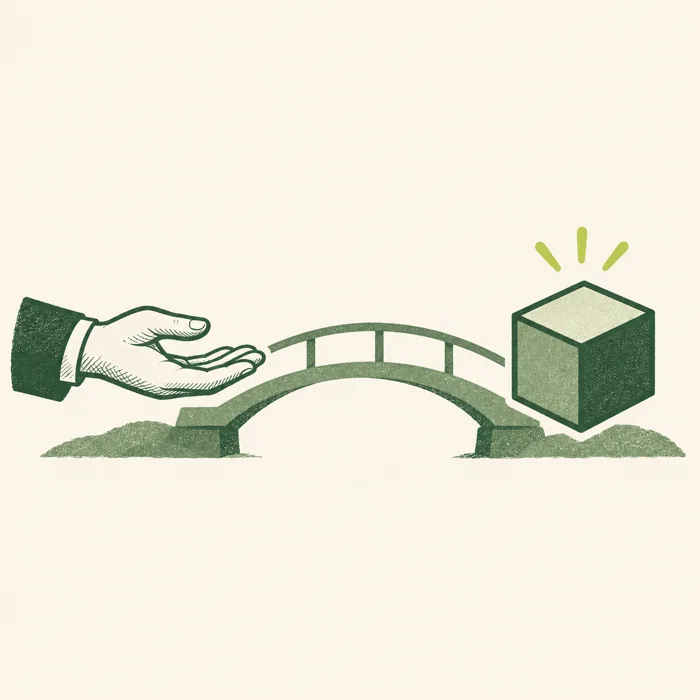
Many successful services companies dream of building a scalable product. The promise of recurring revenue and exponential growth is hard to resist. Yet, this transition is one of the most difficult and common points of failure for a business. It requires more than just a new idea; it demands a complete overhaul of how a company thinks, operates, and measures success.
This article will explore the core challenges of this transition, the indispensable role of a product team, and how to manage the critical tension between safe, predictable services money and the uncertain but lucrative future of a product business.
The Core Challenges of the Transition
Moving from a services to a product model is a total shift in mindset. You're no longer building a solution for a single client; you're building a single solution for a wide, often unpredictable, market.
1. The Financial Gravity of Services
Services companies are built on a simple, comforting truth: billable hours. A signed client contract means predictable revenue. This financial security makes it incredibly difficult to pivot to a product model, where revenue is uncertain and the payback period is long. The temptation to take on "just one more" lucrative client project is a powerful force that can kill your product before it even launches.
2. The Mindset Shift from Reactive to Proactive
A services company is inherently reactive. You respond to a client’s request, build what they ask for, and get paid. A product company, by contrast, must be proactive. You are responsible for identifying an unspoken market need, building a solution, and then finding customers to buy it. This requires a new set of skills: market research, data analysis, and an appetite for risk.
3. Operational and Cultural Whiplash
Your existing team is optimized for a services model. They are experts at project management, hitting client deadlines, and delivering custom solutions. Building a product requires a different operational model—one focused on rapid iteration, A/B testing, and a focus on long-term value over short-term feature delivery. This can cause significant friction and even confusion within the organization.
The Role of the Product Team
In this transition, the product team is the engine that drives your business forward. They are the only part of the organization built to navigate the complexities of this change.
From Client-Led to Market-Led
Your first, most critical task is to stop listening to clients and start listening to the market. A product team’s first job is to ignore the next big custom project and instead conduct the research necessary to find a repeatable, scalable problem. They'll use their skills to identify a problem that multiple potential customers share and are willing to pay to solve.
From Custom Features to Core Solutions
A services company’s backlog is a mix of one-off features and customizations. A product team’s backlog is driven by a strategic roadmap focused on the Minimum Viable Product (MVP). They are responsible for saying "no" to features that don't serve the broader market, ensuring the team is always building for scale.
From Project Manager to Product Owner
The product team takes on the responsibility of managing the roadmap, a living document that balances the needs of the business with the desires of the user. They are the ones who must evangelize the product vision internally and externally, ensuring that every team member, from engineering to sales, understands the strategic "why" behind the new product.
How to Avoid the Pitfalls: Investing in the Future Over "Safe Money"
The biggest challenge in this journey is the constant temptation to take on a services project for a quick cash injection. This is the Tyranny of the Urgent at its most dangerous. To avoid this, you need a clear strategy and unwavering commitment.
1. Create a "Product Bubble"
The only way to protect your product vision is to insulate the product team. Give them a dedicated budget, a clear mission, and a team of engineers that is not available for services work. This ring-fencing ensures that the product team can focus on building the product without being sidetracked by client requests. This can be painful initially, as it requires you to sacrifice short-term revenue, but it is the only way to build a sustainable product.
2. Define Your "Why" and Your "When"
Leadership must be completely aligned on why this transition is critical for the company’s long-term survival. This shared conviction will be tested, so it's important to have a clear trigger point for when the product side of the business will take priority. For example, "When product revenue hits $10,000 in monthly recurring revenue (MRR), we will begin to sunset services work." This provides a clear, data-driven milestone to guide the entire organization.
3. Measure Value, Not Hours
The most significant change is how you measure success. In a services business, you measure billable hours. In a product business, you measure key product metrics like user acquisition, engagement, and retention. The product team must be given the autonomy to experiment and fail, and their success should be measured not by how many hours they log but by the value their product delivers to the market.
The leap from services to products is not for the faint of heart. It requires a significant investment of time, resources, and emotional energy. But by understanding the challenges, empowering your product team, and having a clear plan to navigate the financial tension, you can successfully make the transition from a company that works for its customers to a company that builds for them.