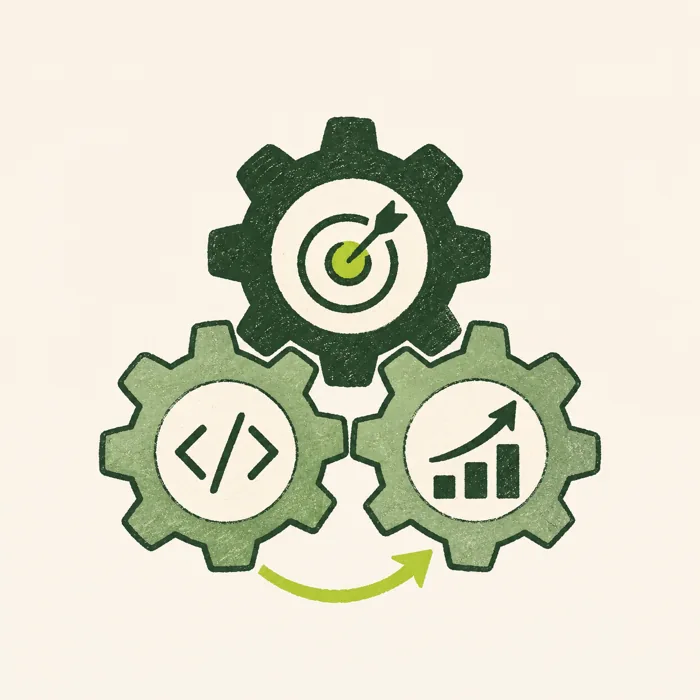
In today's fast-paced market, the difference between a successful product and a failure often comes down to one critical factor: alignment. Product development alignment is the deliberate process of ensuring that a product's strategy, design, and execution are synchronized across all critical functions, particularly Product, Engineering, and Marketing/Sales. This cohesion minimizes wasted resources, accelerates time-to-market, and ensures the final product meets both customer needs and business objectives.2
Product and Engineering: A Continuous Partnership
The relationship between Product Management and Engineering is the core engine of development. It must be a partnership that spans the entire product lifecycle—before, during, and after the build.
Before Development (Defining the 'Why' and 'What')
The initial phase is about moving from an idea to a clear, validated plan. Product leads the charge in defining the problem, and Engineering ensures its feasibility.
Product: The Product team focuses on market discovery, user needs, and business value. They identify the what and the why.
Engineering: Engineers must be brought in early for technical discovery. They assess the feasibility, complexity, and architectural implications of the proposed solution. This prevents building on an unstable foundation or spending time on a feature that is technically impractical or overly costly.
Key Sync: This stage is crucial for managing Scope and Estimates. Product provides the desired customer outcome, and Engineering provides the initial effort assessment. This ensures the roadmap is grounded in technical reality.
During Development (Executing the 'How')
Once work begins, the focus shifts to efficient execution while maintaining flexibility to adapt to new insights.
Product: The PM serves as the chief prioritization officer, ensuring the engineering team is always working on the most valuable items. They field and triage questions, managing trade-offs between scope, time, and quality.
Engineering: The Engineering team is responsible for the how—translating requirements into functioning, high-quality code. They own the technical details, architecture, and deployment process.
Key Sync: Daily stand-ups, sprint planning, and backlog refinement sessions are essential. Engineers need quick, decisive answers from Product to avoid roadblocks, and Product needs transparency into progress and any potential technical debt or unforeseen complexity. Collaboration on User Stories and acceptance criteria ensures the "definition of done" is shared.
After Development (Reviewing and Iterating)
The work doesn't end at launch. This phase is about learning from the real world.
Product: The PM owns measurement and analysis. They track success metrics (KPIs) against the initial goals and gather user feedback.
Engineering: Engineers participate in post-mortems to review performance, scalability, and code quality. They also often handle maintenance, bug fixes, and continuous product improvement based on performance data (Site Reliability Engineering - SRE).
Key Sync: A shared review of customer and performance data (e.g., bug reports, load times, feature adoption) creates a closed feedback loop. Both teams must collaboratively decide on the next set of iterations based on data, not assumptions.
Traditional and Modern Communication Tools
Clear, concise documentation is the foundation of alignment. While older documents were static, modern approaches emphasize living documents and dynamic communication.
The Classics: MRD and PRD
Market Requirements Document (MRD): Traditionally written by Product Marketing or Product Management, the MRD focuses on the market problem, the target audience, the competition, and the business opportunity (the why). It guides the overarching product strategy.
Product Requirements Document (PRD): The PRD is the internal blueprint for the development team. It defines the specific features, functionality, and user experience (the what). It includes user stories, acceptance criteria, and technical constraints, bridging the gap between market need and technical specification.
Newer Ways to Communicate and Sync
In the world of Agile and continuous delivery, documentation has become more lean and dynamic, favoring direct, high-frequency communication.
| Tool/Method | Focus | Purpose in Alignment |
| Shared Roadmapping Tools | Visual, dynamic plan | Provides real-time transparency into priorities, status, and dependencies for all teams (Product, Engineering, Go-to-Market). |
| Product-Centric OKRs | Shared, measurable goals | Ensures all teams are aligned on outcome-based metrics (e.g., increase customer retention by X%), not just output (e.g., ship feature Y). |
| Cross-Functional Stand-ups/Demos | Quick, daily/weekly sync | Engineering shows working software, and Product/Marketing/Sales see progress and give immediate feedback. Breaks down silos. |
| User Stories & Acceptance Criteria | Small, actionable units of work | A shared language used by Product and Engineering to clearly define what must be built and how success will be measured. |
Aligning with Marketing and Sales (Go-to-Market)
Product-Go-to-Market alignment ensures the product being built is the product the market needs and that the whole company is ready to sell and support it.
Product's Role: The Product team translates the PRD's features into tangible customer value (the value proposition) for Marketing and Sales. They are responsible for sales enablement—training the Sales team on the product's capabilities, target customers, and competitive advantages.
Marketing/Sales' Role: These teams provide voice of customer (VoC) feedback to Product, informing the roadmap with crucial data on customer pain points and sales objections. They use the product's value proposition to create launch strategies, messaging, and sales materials.
Key Sync: Alignment is achieved by including Marketing/Sales in product demos and having them review messaging against the product's true capabilities to prevent over-promising. Collaboration on launch timing ensures the product is ready when the campaign breaks, and the sales team is fully prepared to sell the new features.
Summary: The Blueprint for Success
Product development alignment is the deliberate process of transforming market opportunity into delivered customer value through synchronized efforts.
- Product & Engineering Partnership: This core relationship spans the entire development lifecycle, from technical discovery (before) and continuous prioritization (during) to performance review and iteration (after).
- Communication Tools: While traditional documents like the MRD and PRD provide a foundational structure, modern Agile teams rely on dynamic roadmapping, OKRs, and frequent cross-functional collaboration to maintain real-time sync.
- Go-to-Market Integration: Product acts as the bridge, translating features into value for Marketing and Sales, while those teams provide critical market feedback to keep the roadmap grounded in customer reality.
By eliminating functional silos and establishing a shared source of truth—whether through classic documentation or modern digital tools—organizations ensure that every feature built contributes directly to the overall business strategy.