Now, it's time to look outward and understand your place in the competitive landscape. This next step is about mastering two critical skills: analyzing your competition and telling a story that makes your company unforgettable.
Analyzing Your Competition
Your first instinct might be to list your direct competitors, but a true competitive analysis goes much deeper. It’s about understanding the entire competitive landscape—the full ecosystem of solutions (both direct and indirect) that your target customer uses today.
Step 1: Map the Landscape
Start by identifying three types of competitors:
Direct Competitors: Companies solving the exact same problem for the same audience. (e.g., Tesla vs. Rivian).
Indirect Competitors: Companies solving the same problem with a different approach. (e.g., A car vs. a motorcycle).
Substitute Competitors: The most overlooked group—the status quo. This is what your customer is doing today without your product. (e.g., Using a spreadsheet instead of a SaaS tool).
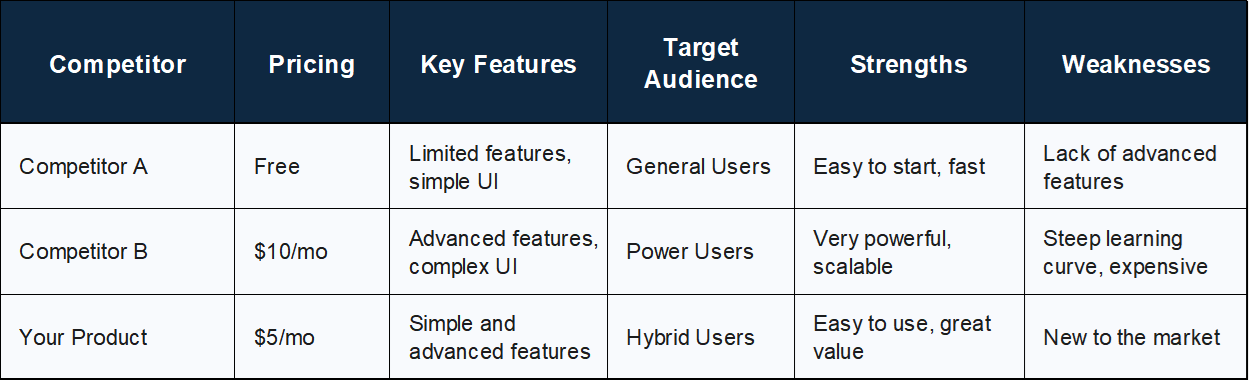
Step 2: Create a Competitive Matrix
Once you have your list, create a simple matrix to compare them. Focus on what matters to your customer, not just on features.
Step 3: Get Hands-On
Don't just rely on their websites. Sign up for their free trials, talk to their customers, and read their reviews. Understand their pricing and business models. This hands-on research will give you a level of insight you can't get from a simple Google search or asking ChatGPT.
Positioning Your Product
Now that you've analyzed the competition, it's time to define your unique position in the market. Positioning is the act of deciding what you want to be known for. It's a statement that differentiates you and explains why a customer should choose you over anyone else.
The goal is to find your "Blue Ocean"—a market space free of competition. You do this not by fighting your competitors on their terms, but by redefining the rules.
Creating Your Positioning Statement
The simplest way to start is with a straightforward statement that every employee can understand.
For [your target customer] who [has a problem], our product is a [category of product] that [provides a key benefit or solves the problem].
Example: For busy parents who struggle to find time for home-cooked meals, our product is a smart refrigerator that automatically orders groceries and suggests simple recipes.
This statement is the source of all your messaging, from your website copy to your sales pitch.
Building Your Narrative: The Art of Storytelling
In a crowded market, facts and features are not enough. You need to build a compelling story that connects with your audience on an emotional level. Your story is the backbone of your brand.
The Elements of a Powerful Story
Your story isn't about you; it's about your customer. Every great story has three key characters:
The Hero (Your Customer): The person facing the challenge. They are the protagonist in your story.
The Villain (The Problem): The obstacle, pain point, or the "bad guy" in their life. This could be a legacy system, an inefficient process, or a difficult task.
The Guide (You): You are not the hero. You are the mentor who provides the hero with a plan, a tool, and the confidence to overcome their villain. Your product is the magic weapon.
How to Tell Your Story
To effectively tell this story, you need to articulate each of the three elements clearly.
Define Your Hero: Don't just say "startups." Describe the founders' struggle with manual data entry. Paint a picture of them working late nights, frustrated by repetitive tasks. Make their pain tangible.
Clarify the Villain: Frame the problem as a real enemy. Is it the inefficiency of legacy systems? The hidden costs of manual processes? The fear of a data breach? Give the problem a name and a face, and show how your hero is losing the battle against it.
Embody the Guide: Explain how you and your product offer a clear path to victory. You are the expert who understands their pain and provides the solution. Your story should show your product as the tool that empowers the hero to defeat the villain and achieve a better future.
Example Story: Mailchimp
Let's look at one of the most successful examples of a hero's journey in branding: Mailchimp.
The Hero: For years, the hero was the solo entrepreneur or small business owner. They were passionate about their work but felt intimidated by marketing. They saw traditional email marketing as a complex, expensive, and intimidating task meant for "real marketers." Their villain wasn't a competitor, but the overwhelming complexity of the task itself.
The Villain: The villain was the status quo: the idea that email marketing was difficult, technical, and only for big corporations. This villain was embodied by clunky, corporate-looking software and a marketing industry that used complicated jargon.
The Guide: Mailchimp positioned itself as the friendly, quirky guide. They weren't a big, powerful solution; they were a simple, fun, and easy-to-use ally. Their brand mascot, a cartoon chimp, and their playful tone (e.g., "High-five!" after you send an email campaign) gave the hero the confidence to fight the villain. Mailchimp provided the easy-to-use tool and a friendly voice that said, "You can do this."
This narrative should be present in every part of your communication, from your website's home page to your pitch deck.
Your story is what will make you memorable in a sea of similar products. It's what will turn a customer into a fan, and a product into a movement. With a solid understanding of your competition and a compelling story, you are now ready to launch your product and change the world.